Capital One · 2025
Solution Finder & Presentment

65% of customers in financial hardship were leaving without a resolution — and the product was the reason why
When customers fall behind on an auto loan, every day without a resolution is a day closer to repossession. Capital One had built a digital path — Help Me Catch Up — designed to route delinquent customers to the right repayment option for their situation. The entry point was Solution Finder: a short qualifying questionnaire that, in theory, made the process fast and self-serve.
In practice, 65% of the customers who arrived at that page left without finishing it. Not because the options were bad. Not because the product didn't work. Because the product didn't speak their language — and nobody had caught it.
The questionnaire was built around Capital One's internal taxonomy — not how customers think about their own situation
A 35% click-through rate is a product failure disguised as a metric. It means that for every customer who found a path forward, two more hit a wall and gave up — at the exact moment they needed help most.
The flow asked customers to navigate Capital One's internal categorization of hardship types: financial terms they didn't recognize, options presented without enough context to distinguish, and no signal that completing the questionnaire would actually lead somewhere useful. The design assumed customers understood the system. Customers in financial stress, often using the app in a moment of crisis, did not.
The business consequence was direct: customers who couldn't self-serve escalated to agents or churned entirely. Each unresolved delinquency carried real downstream cost — in call volume, in charge-off risk, and in customers who stopped trusting that Capital One would work with them.
I ran a targeted A/B test before touching the design — to isolate the cause, not just treat the symptom
My first move wasn't a redesign. It was a diagnostic. I needed to know whether the drop-off was caused by confusing language, unclear structure, perceived length, or something deeper — because each of those problems has a different solution, and designing for the wrong one would waste time and produce nothing.
We ran variants testing simplified, situation-first question framing against the original taxonomy-based approach. Critically, we instrumented drop-off within the flow — not just whether customers finished, but exactly where they stopped. The test confirmed the hypothesis: customers weren't abandoning because the options were wrong for them. They were abandoning because the questions required them to think in categories they didn't have.
Framing was the friction. That meant the fix was a rewrite, not a reskin.
Reframe every question around the customer's experience — not our internal structure
Armed with the diagnostic signal, I led the full redesign. The core shift: every question was rewritten to meet customers where they were. Instead of presenting Capital One's categorization of hardship types, we asked about the customer's actual situation — what's happening right now, what does your week look like, what kind of breathing room do you need. The system did the routing. The customer just had to be honest.
To keep design decisions grounded in real constraints from the start, I launched a weekly Design Jam — a standing cross-functional session with product, content strategy, legal, compliance, and engineering. Legal and compliance review had historically arrived late, after work had hardened, creating expensive revision cycles. Bringing them in weekly meant their feedback shaped decisions in progress, not after the fact. It cut weeks of back-and-forth from the delivery timeline.
After launch, click-through rate climbed from 35% to 75%. For a customer in financial hardship, the difference between a 35% and 75% completion rate isn't a dashboard improvement — it's the difference between finding a way out or not.
More customers were completing the questionnaire — and then hitting a wall I hadn't noticed before
Once Solution Finder was performing, I looked downstream. And I saw a structural gap that the low CTR had been masking all along.
After completing the questionnaire, customers were being dropped directly into the full details of a single repayment option — all the terms, all the disclosures, the complete picture — with no intermediary step to orient them. No way to see what else they qualified for. No way to compare before committing.
The Cross-Domain Insight
This experience was sending customers straight to a product detail page without ever showing them the shelf. In e-commerce, that's a known conversion killer — you don't ask someone to buy before they've had a chance to browse. Capital One had solved the questionnaire problem and left the discovery problem completely untouched.
I proposed Presentment: a new intermediary layer that sat between the questionnaire and the individual option details, surfacing everything a customer qualified for before asking them to go deep on any of it. It wasn't in the original scope. It became the more important piece of work.
Orient first. Decide second. Commit when ready.
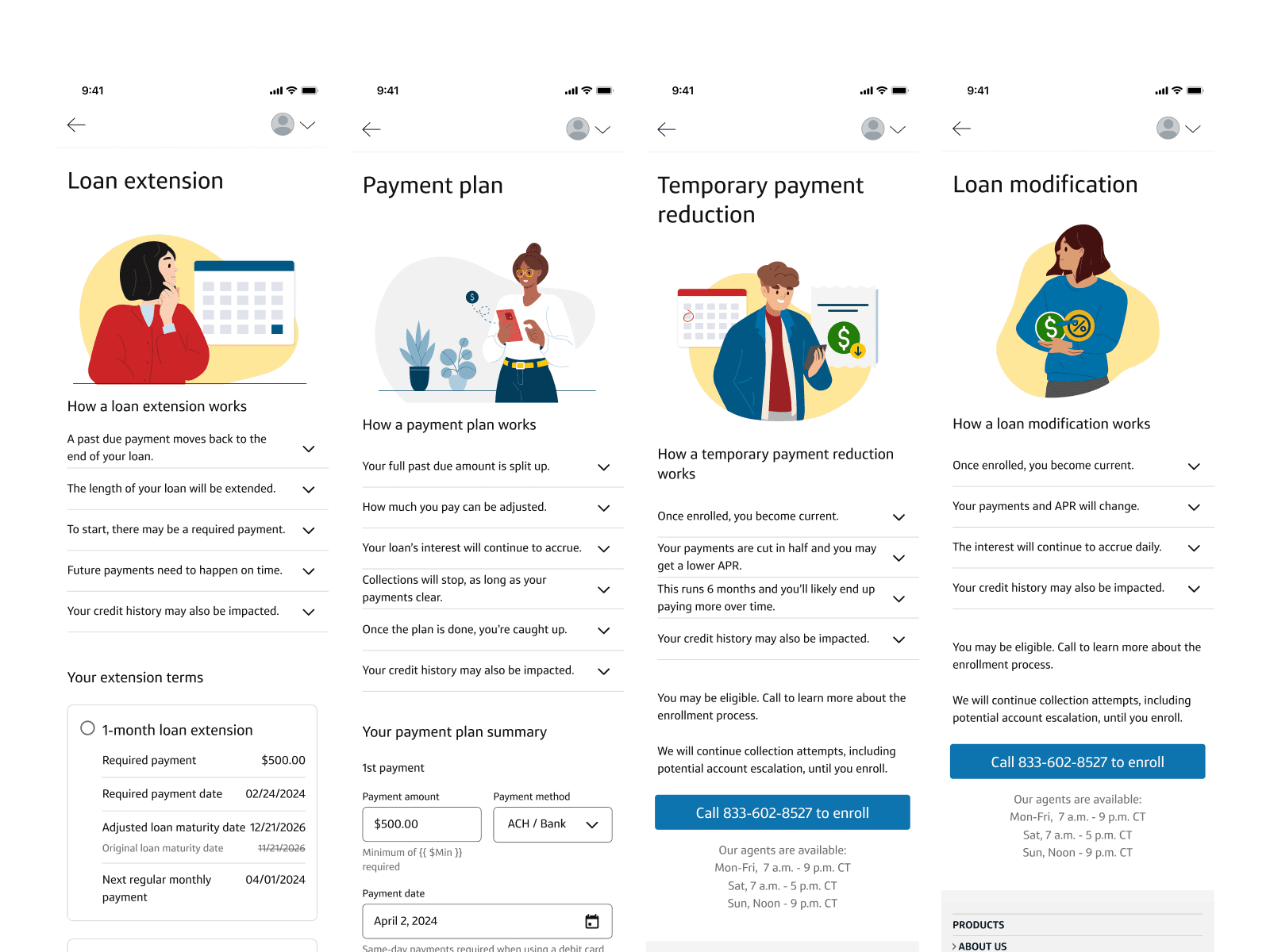
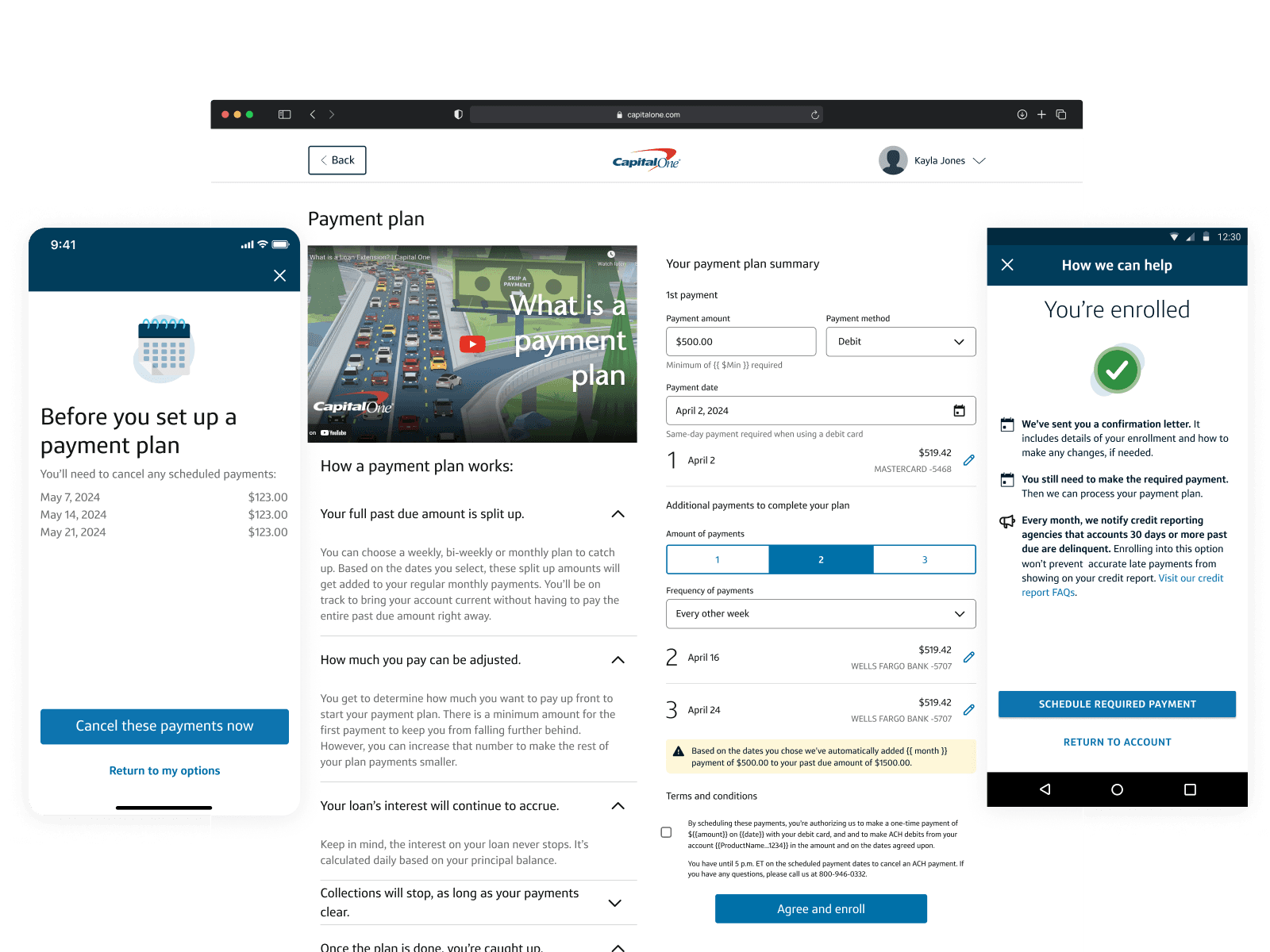
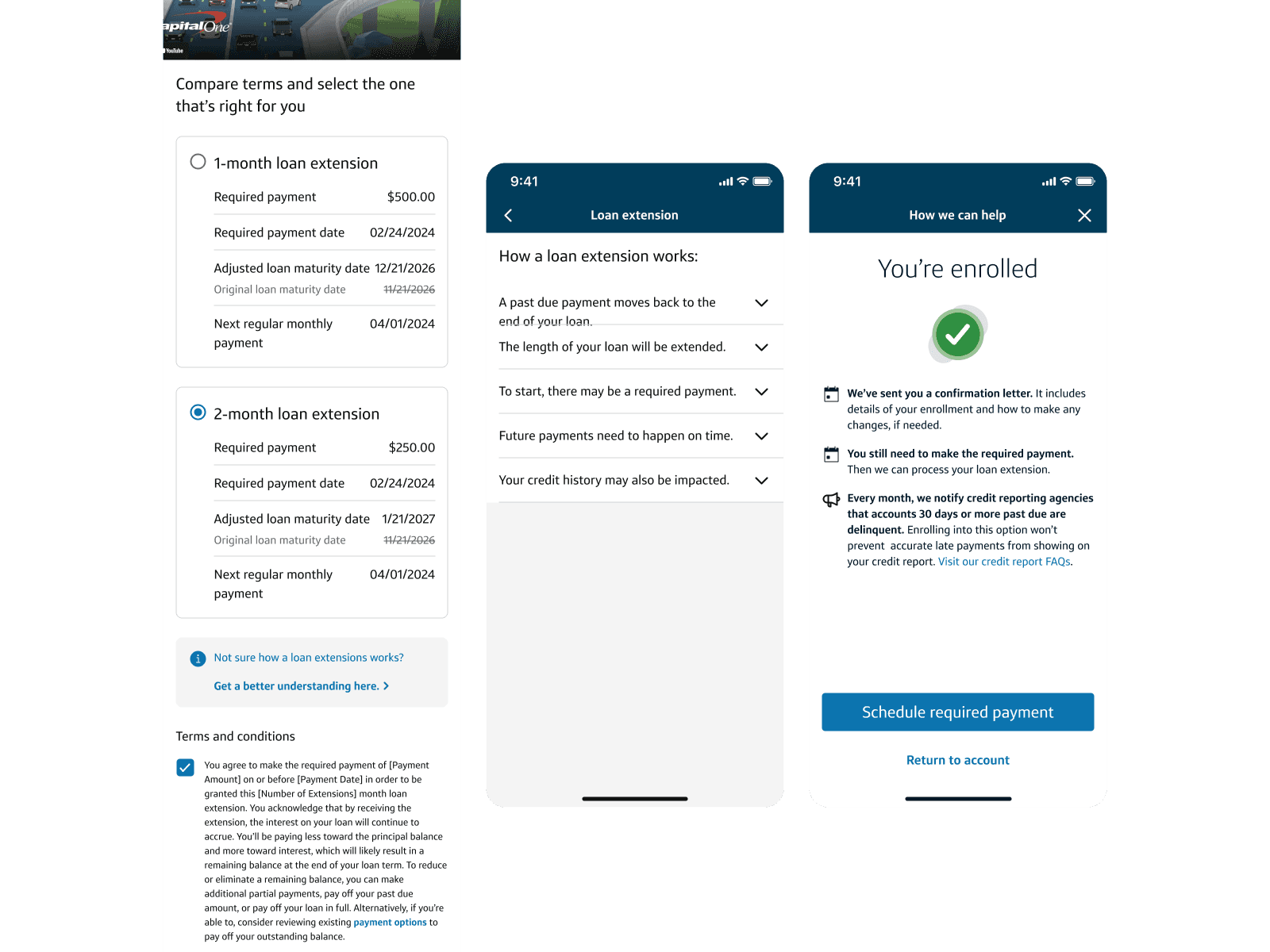
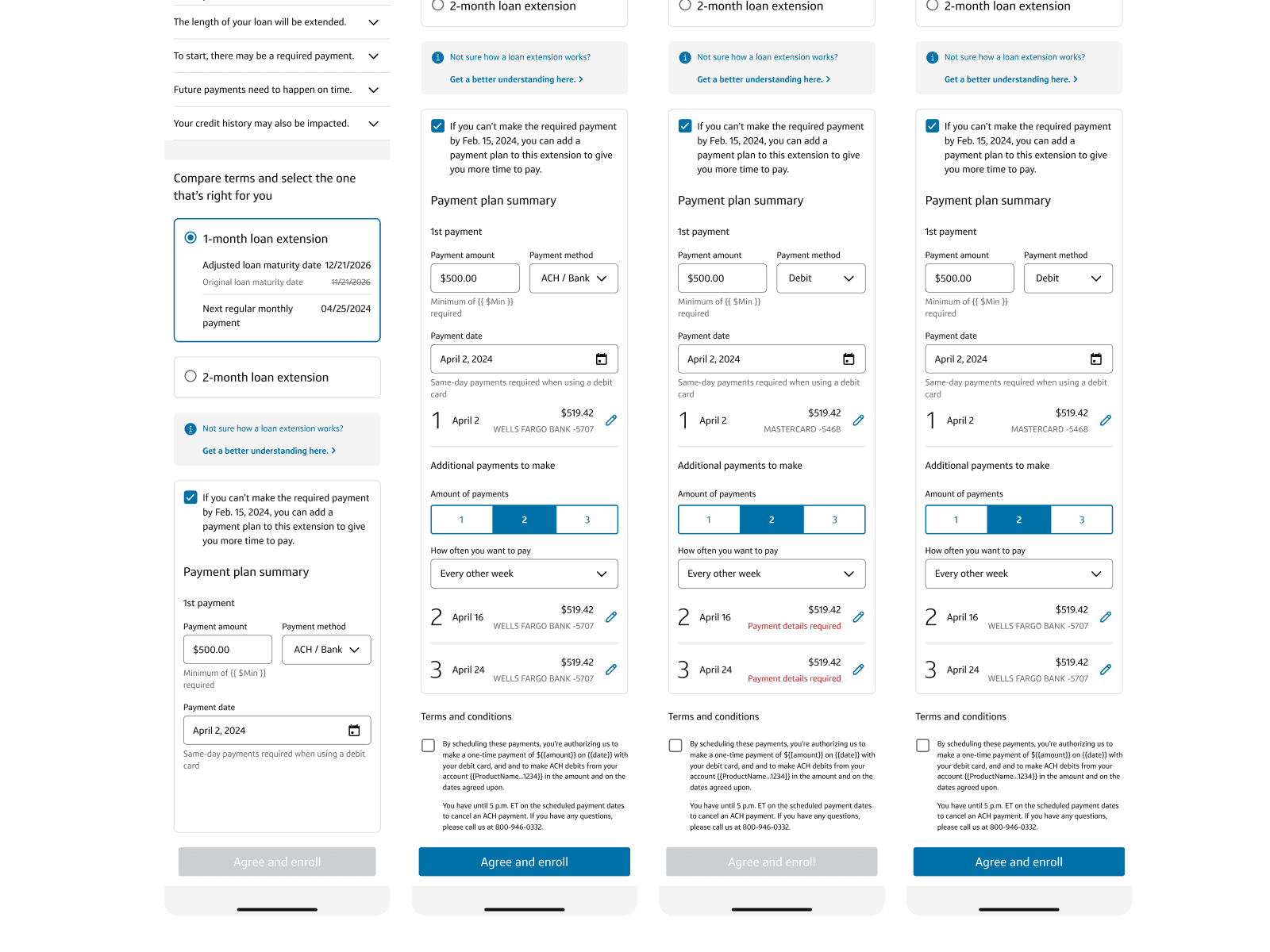
The Presentment screen surfaced each option the customer qualified for — payment plan, loan extension, deferral, and others — as a scannable set of cards. Each card led with the terms that actually mattered at a glance: what the option does, what it costs, and how it affects the account. Customers could tap into any option for the full detail and legal disclosures — but only when they chose to.
The design put depth in the customer's control. They could orient across all their options first, then decide where to go deeper, rather than being forced to absorb full complexity before they'd had a chance to get their bearings.
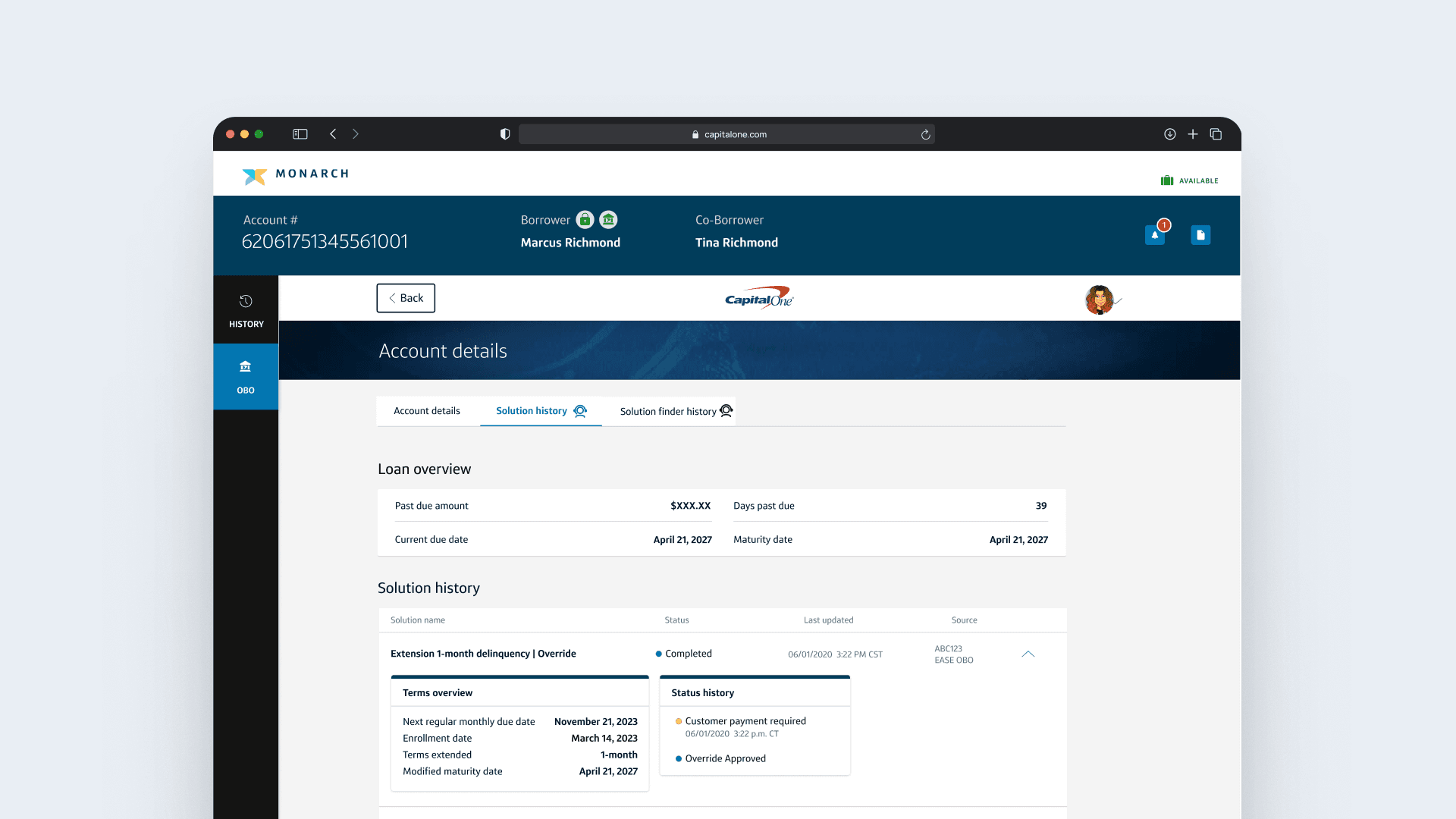
Building Presentment required something the design work alone couldn't do: turning an eligibility logic that lived in agents' heads into a reliable, auditable, testable system. I worked across governance, legal, compliance, and engineering to map the full eligibility matrix — credit rules, account history, policy conditions, timing constraints — and architect a modular system that could surface the right options for each customer and accommodate new options without rebuilding the underlying logic.
Diamond Award. More customers resolved digitally. And a transparency gap that became its own initiative.
Together, Solution Finder and Presentment drove a significant increase in digital resolutions and reduced agent call dependency across the full hardship flow. Customers who had been abandoning the experience without help were now completing it — finding a path forward without needing to call.
What Came Next
Presentment surfaced something we hadn't anticipated: once customers could see all their options side by side, they wanted to understand how each choice affected their account over time — not just today. That question became the seed of a separate initiative. The design didn't just improve a flow. It revealed what the flow had never been asking.
Next Project
Capital One · 2025
Overrides
Replaced a manual process with a scalable digital tool.